
DECISION LAYER
Keep the gun firing, then multiply the events it creates.
Marcus is the clearest route for learning the game's core decision: frequent, reliable shots are worth more than a rare item that starts an unrelated engine.
WEAPON DECISION
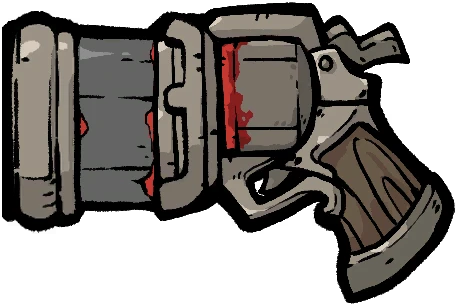
Recommended weapons, with a fallback
Use the first weapon as the route anchor. The other two are pivots for the run you actually get.
Why it fits. Best starting anchor for the extra-shot and first-shot rhythm.
Tradeoff. Five rounds means reload downtime is the first problem to solve.
Why it fits. A physical fallback when the Musket does not appear and Hemorrhage still fits the route.
Tradeoff. Do not swap just for rarity if the current gun is firing more reliably.
Why it fits. A crowd-control pivot when the run has already lost its Physical support.
Tradeoff. Changing element abandons Hemorrhage progress; treat it as a real pivot.
RUN TIMELINE
Early, mid, and late choices
The right item changes as the run moves from establishing a loop to protecting a clear.
Create a repeatable shot event.
Look for: Vintage Musket, Geminate Shot+, and Reload Speed or Fire Rate.
Checkpoint: If the gun is still waiting on long reloads, do not chase crit yet.
Turn uptime into more projectiles.
Look for: Quick Fire, Triple Shot, Bullet Attack, then a matching element relic.
Checkpoint: The route is working when ordinary fire produces several useful events per magazine.
Convert volume into a stable boss finish.
Look for: Critical Chance, Critical Damage, Emperor's Holy Sword, and reload support.
Checkpoint: Keep one reliable damage channel; do not add a second engine just because it is rare.
MATCHUP TEST
Boss damage and crowd clear are different jobs
Use reload support and crit payoff once the target stays alive long enough for repeated first-shot windows. Keep firing discipline; a burst that spends half the fight reloading is not a boss plan.
Extra shots, fire rate, and a weapon that spreads pressure are the priority. If packs are the failure point, Bullet Attack and volley effects beat a greedy single-target card.
RNG RECOVERY
What to do when the core item is missing
Geminate Shot+ or the Musket never appears by the middle of the run.
Keep the physical element, choose Fire Rate and Reload Speed, and use Demonhunter Crossbow or any reliable physical family.
Do not hold empty slots for one exact skill while the current weapon has no uptime support.
KEEP MOVING
Turn the advice into the next decision
Search the exact item, compare its trigger, then load this route into the Planner. The goal is a useful next pick, not a perfect shopping list.
THE SHORT VERSION
Pick Marcus. Keep the Vintage Musket until a replacement clearly produces faster, safer shooting events. Prioritize Geminate Shot+, Quick Fire, and Triple Shot. Add Reload Speed, Fire Rate, Bullet Attack, and crit in that order when the choices are comparable.


Your first three decisions
- Build the shot engine. Marcus chains Geminate Shot and Fatal Silver Bullet from ordinary shooting. Frequent, reliable weapon events give the engine more chances to work.
- Remove reload downtime. The Vintage Musket has five rounds. Reload support keeps the build active instead of waiting between bursts.
- Add crit after uptime. The Musket already has a critical identity, so crit becomes efficient once the build can keep firing.
Know the weapon you start with
The Vintage Musket is a five-round Physical rifle firing at four shots per second, with a 10% base Critical Chance and 20 Hemorrhage buildup per hit. Two of those numbers explain the whole route. The five-round magazine means you reload constantly, which is why Reload Speed support is treated as core rather than optional. The 10% base crit means the weapon already has a critical identity, so crit pickups scale something real instead of starting from zero.
Higher-quality Muskets roll effects built around the first shot of a magazine — a crit window that a fast-reloading build opens over and over. That is the quiet synergy of this route: the same reload support that keeps your uptime high also resets the first-shot window more often. You do not need a rare drop for the route to work, but when a higher-quality Musket appears, this is why it is usually worth taking over a sidegrade of another weapon.
Skill order
| Priority | Skill | Why it fits |
|---|---|---|
| 1 | Strengthens the extra-shot half of Marcus's core loop. | |
| 2 | Supports a faster shooting rhythm and more trigger opportunities. | |
| 3 | Commits the late branch to additional projectile events. | |
| Fallback | Use it when the run already has stable shot frequency. |
Relic and Tarot checklist
- Emperor's Holy Sword when Critical Chance is already part of the run
- Magician's Hat when reload downtime breaks the firing loop
- Current-version support for Fire Rate, Reload Speed, Bullet Attack, or the active element
- The Emperor (Upright) when the run already has several Critical Chance sources
- The Lovers only when the Sub Weapon contributes a useful effect
Emperor's Holy Sword is a direct crit package. The Emperor (Upright) becomes stronger when the run already owns several sources of Critical Chance. Magician's Hat is the cleaner uptime choice: faster reloads and a chance to finish reloading immediately.
When to switch weapons
Switch only when the new weapon preserves the engine: frequent hits, practical range, manageable reloads, and a weapon effect worth triggering repeatedly. A higher rarity that shoots slowly or forces unsafe positioning can be a downgrade for this route.
Keep the Sub Weapon when it covers a real weakness or when The Lovers lets its weapon effect, part passive, or battle skill contribute to the main plan.
If the perfect items do not appear
If crit support never appears, keep the extra-shot core and test Bullet Attack, Fire Rate, Reload Speed, and the current weapon element.
V1.0.479 changed several trigger categories. Check the current effect text before building around Lightning, Disruption, Ultimate, Transmutation, or Physical interactions.
Common first-run mistakes
- Chasing rarity over fit. A legendary weapon that fires slowly does not feed an extra-shot engine. On this route, frequency beats rarity until the engine is running.
- Taking crit before uptime. Critical Damage on a build that spends half its time reloading multiplies downtime, not damage. Fix the firing loop first; the crit picks get better on their own.
- Spreading across elements. Every off-element pickup dilutes the run. If a choice does not support shooting faster, reloading faster, or hitting harder with the current weapon, it is probably a skip.
- Treating the Sub Weapon as free value. Without The Lovers, a Sub Weapon mostly occupies a slot. Pick it for the weakness it covers, not because the slot exists.
Test the route before you commit a run
The fastest way to internalize this blueprint is to assemble it in the build planner, which scores the synergy and flags conflicts before you are mid-run with a timer on the screen. And because the developers are patching several times a week, check the current patch notes before leaning on any older guide — 1.0.466 added trigger caps that specifically changed how repeat-trigger builds resolve.
Data references
Character, skill, weapon, relic, and Tarot relationships were checked against the current English database at Hunter Archive. Patch-sensitive claims are checked against the official Steam update feed.